
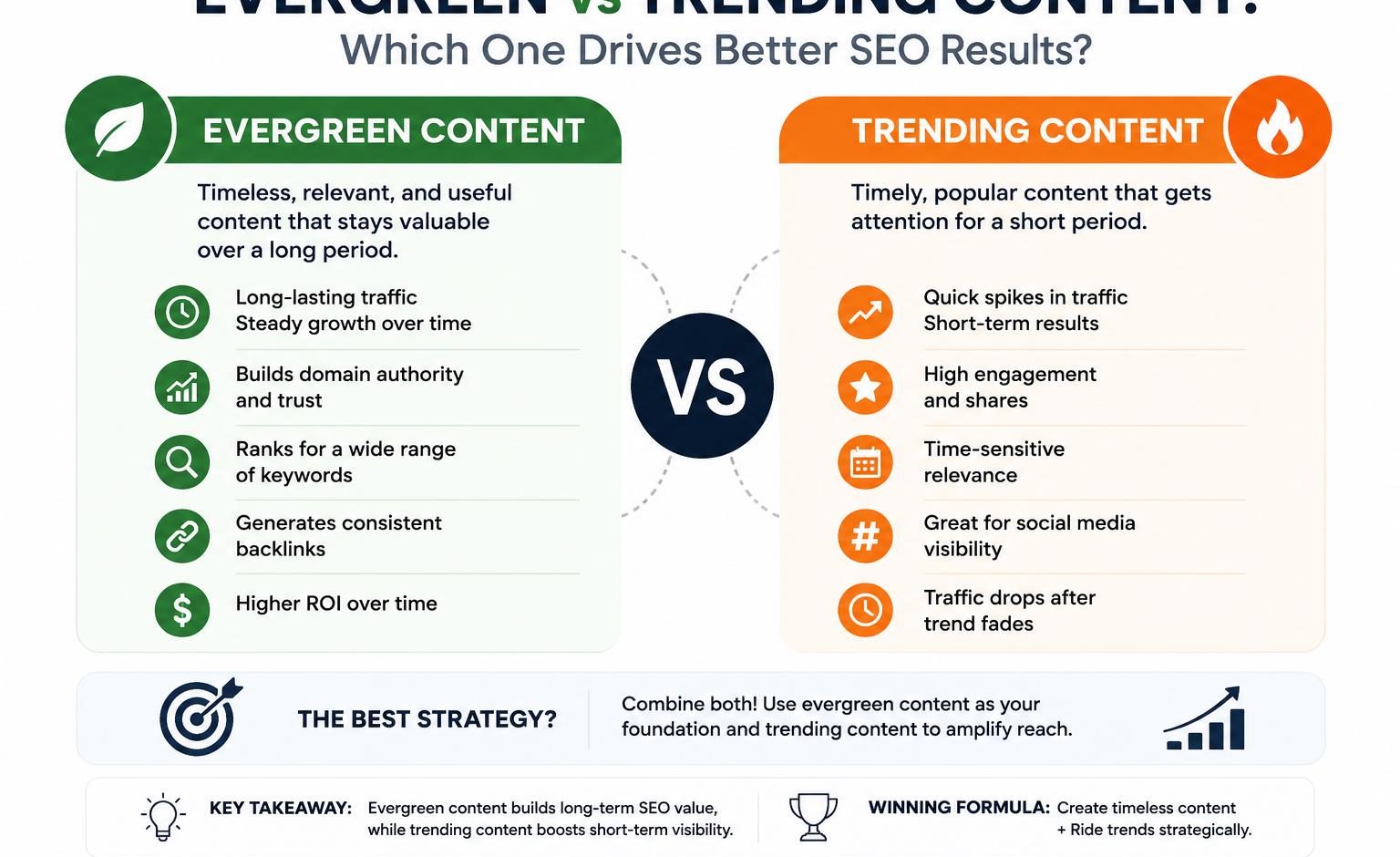
Every content decision you make is ultimately a bet on where your traffic will come from and how long it will last. The debate around evergreen vs trending content sits at the heart of that decision and it is one that affects businesses, bloggers, agencies, and content creators of every kind.
Both have genuine value. Both serve different strategic purposes. And the businesses that tend to build the most durable SEO results are the ones that understand not just what each type of content does, but when to use which and how to integrate them into a coherent, long-term content planning framework.
Evergreen content addresses topics, questions, and problems that remain consistently relevant over time. The term comes from the evergreen tree which retains its foliage year-round regardless of season and the analogy holds well.
What Is Trending Content?
Trending content is built around topics, events, conversations, or search behaviours that are experiencing a spike in interest at a specific point in time. A piece of trending content is deliberately timely it is designed to be discovered while the moment it addresses is still active.
Examples include news commentary, analysis of industry announcements, responses to viral events, seasonal guides tied to specific dates, breakdowns of algorithm updates, product launch coverage, and reaction pieces to cultural moments.
How Each Type Affects Ranking Longevity
Ranking longevity the ability of a piece of content to continue generating organic traffic over an extended period is one of the most important dimensions of content performance for any SEO strategy.
Evergreen Content and Long-Term Rankings
Evergreen content is specifically designed with ranking longevity in mind. Because the topics it addresses remain relevant, the search demand that drives traffic to it does not evaporate.
The compounding nature of evergreen content performance is one of its most significant advantages. As a piece accumulates time in the index, backlinks from other sites, user engagement signals, and internal links from newer content on the same domain, its ranking position tends to strengthen rather than decay.
Trending Content and Ranking Decay
Trending content operates on a fundamentally different performance curve. When published at the right moment while search volume for the topic is rising or at its peak a trending piece can achieve rapid ranking gains and significant traffic in a short window.
This does not mean trending content leaves nothing behind. A piece that earned backlinks during its peak still carries those links forward. If the topic eventually stabilises into a lower but persistent level of ongoing interest, a well-structured trending article may retain some residual ranking value.
For businesses focused on building durable organic traffic channels, the ranking longevity of evergreen content makes it the foundational investment. Trending content supplements that foundation but cannot replace it.
How Each Type Contributes to Authority Building
Authority building establishing your domain and your brand as a credible, trusted source within your niche is a slower, less linear process than ranking for individual keywords. But it is one of the most strategically important outcomes of a well-executed content programme.
Evergreen Content as an Authority Asset
Comprehensive, well-researched evergreen content is one of the most powerful tools available for authority building. When a site consistently publishes in-depth guides, thorough explainers, and genuinely useful resources on topics within its niche, several things happen over time.
Other sites and content creators begin to reference and link to those resources as reliable sources. Search engines recognise the topical depth and consistency of the domain and begin to associate it with expertise in that subject area.
Trending Content and Short-Term Authority Signals
Trending content can contribute to authority building, but in a different and more narrow way. A site that consistently produces timely, accurate, and insightful commentary on developments in its industry sends a signal to its audience and to some degree to search engines that it is current, engaged, and worth following.
When trending content earns significant backlinks and social shares during its peak, those signals contribute to the domain’s overall authority profile. A single piece of trending content that earns fifty high-quality backlinks during its peak is a meaningful authority event, even if the traffic from that specific article subsequently declines.
The Role of Content Planning in Balancing Both Types
The most effective Local SEO content strategies are not built entirely on one type of content or the other. They are built on deliberate content planning that assigns the right role to each type of content within a coherent overall programme.
Building the Evergreen Foundation First
For most businesses particularly those in the early to middle stages of their SEO investment the priority should be building a strong foundation of evergreen content before devoting significant resources to trending coverage.
The reason is straightforward: evergreen content generates compounding returns, and those returns begin accumulating from the moment the content is published.
Layering Trending Content Strategically
Once an evergreen foundation is in place, trending content can be layered in strategically to capture moments of elevated search demand, demonstrate currency and relevance, and generate short-term traffic spikes that complement the slower-building baseline of evergreen traffic.
The key word here is strategically. Producing trending content purely because a topic is generating social media noise without any consideration of whether it is relevant to your audience or whether it can be executed with sufficient quality and speed to be useful is rarely a good use of content production resources.
Creating a Content Calendar That Serves Both
Practical content planning for a balanced evergreen and trending strategy typically involves maintaining two parallel tracks within a content calendar. The first track covers the steady production of evergreen content articles and guides planned well in advance, researched thoroughly, and optimised carefully for stable keyword targets.
The second track maintains capacity for responsive, timely content keeping a portion of your content production bandwidth available for trending topics that are directly relevant to your audience and that can be executed well on short notice.
Practical Signals for Choosing Between the Two
When evaluating any potential content topic, a few practical signals help clarify whether it belongs in the evergreen track or the trending track of your content planning.
- Search volume stability: If the keyword or topic shows stable, consistent search volume in tools like Google Search Console or keyword research platforms, it is a candidate for evergreen treatment.
- Content shelf life: Ask honestly how useful this content will be in twelve months. If the answer is “just as useful as today,” it is evergreen.
- Production speed requirement: Evergreen content benefits from thorough research, careful structure, and detailed optimisation it can be planned weeks in advance.
- Backlink potential: Evergreen content earns backlinks gradually and consistently over time as people discover and reference it.
Refreshing Evergreen Content Over Time
One of the most underutilised levers in a long-term content planning strategy is the systematic refreshing of existing evergreen content.
Because evergreen articles are designed to remain relevant over time, they do not require complete rewrites but they do benefit from periodic reviews to ensure the information remains accurate, examples are current, and any statistics or references are up to date.
Refreshing a well-performing evergreen article can reinvigorate its rankings, signal to search engines that the content is actively maintained, and extend the asset’s useful life significantly.
Conclusion
The evergreen vs trending content debate is ultimately not a debate about which type is better it is a question of understanding what each type is for and deploying both in a way that serves your long-term SEO goals.
Evergreen content is the engine of sustainable organic traffic. It builds authority, compounds over time, and creates the stable foundation on which a durable SEO programme is constructed.
Trending content is the accelerant. When executed well and timed correctly, it generates short-term traffic spikes, earns rapid backlinks, and signals to your audience that you are engaged and current. Contact us for more information about evergreen vs trending contents.
FAQ’S
Q1: Which performs better for SEO evergreen or trending content?
Ans. For long-term, sustainable SEO performance, evergreen content consistently outperforms trending content. Its ranking longevity means it continues generating organic traffic long after a trending piece has faded.
Q2: How does evergreen content support authority building?
Ans. Evergreen content builds authority by demonstrating consistent, in-depth knowledge across the topics that matter to your audience.
Q3: Can trending content contribute to ranking longevity in any way?
Ans. In most cases, trending content is not designed for ranking longevity its primary value is capturing a moment of elevated demand before it passes.
Q4: How should content planning balance evergreen and trending content?
Ans. For most businesses, a content planning approach that prioritises evergreen content as the foundation perhaps seventy to eighty percent of production while maintaining capacity for selective trending coverage makes strategic sense.
Q5: How often should evergreen content be updated?
Ans. Evergreen content benefits from periodic review and refreshing typically on an annual basis for well-performing articles. The goal is not a complete rewrite but rather a check to ensure information remains accurate, statistics and references are current, and the content continues to serve the search intent of its target keyword effectively.